
Our expertiseS
Structural mechanics
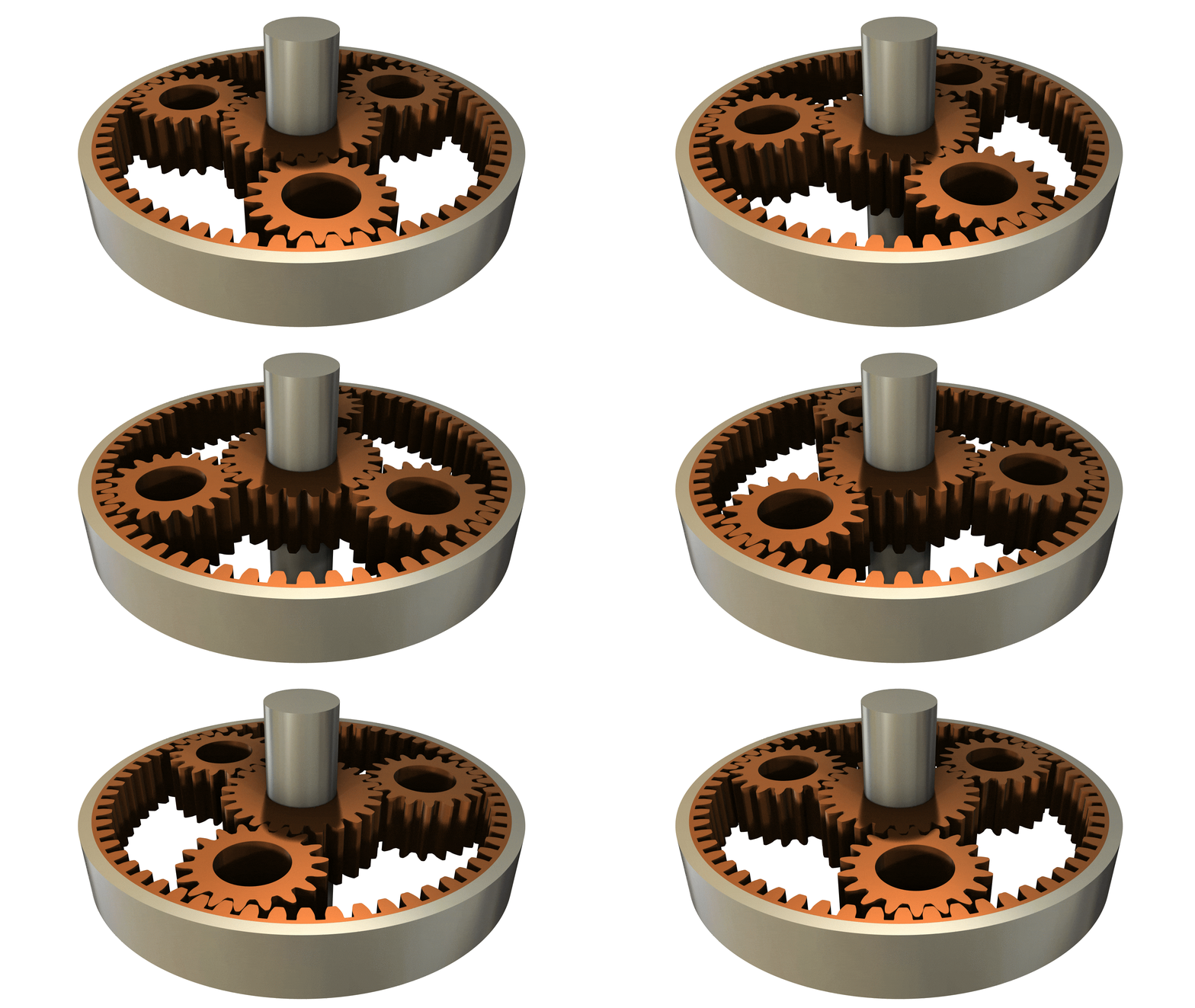
Predict the mechanical behavior of your structures
Structural mechanics simulation makes it possible to predict the mechanical behavior of a part or assembly before it is manufactured. It is an essential tool for sizing a product, optimizing its design, extending its service life, and preventing the risk of failure.
SIMTEC develops numerical models using COMSOL Multiphysics® to analyze stresses, deformations, vibrations, and interactions between different physical phenomena. Our multiphysics approach makes it possible to accurately represent the actual behavior of your structures under their operating conditions.
Expertise in material behavior
SIMTEC is an expert in the characterization and implementation of mechanical material behavior laws adapted to your materials.
We model, in particular:
- Elasticity and hyperelasticity;
- Viscoelasticity, in linear elasticity or large deformations;
- Plasticity, viscoplasticity, and creep;
- Large deformations;
- Customized material behavior laws, developed to accurately represent the rheology of specific materials.
As a first step, we determine the most suitable material behavior law to effectively describe the rheology of your part. This step is essential to ensure the reliability and accuracy of the simulations.
Simulations representative of real-world conditions
We then analyze the mechanical behavior of your parts when subjected to:
- mechanical stresses;
- thermal gradients;
- fluid-structure interaction (FSI);
- contact with another part.
Our models also take into account:
- contact mechanics;
- tribology (friction, wear, and interactions between surfaces);
- natural frequencies, vibration modes, and resonance phenomena.
Improve the reliability of your designs and extend their service life
Simulation makes it possible to accurately identify areas subjected to the highest mechanical stresses. This knowledge is essential for anticipating the risk of failure, carrying out fatigue studies, and improving the robustness of structures.
Our calculations can be used to optimize, in particular:
- the design of your parts;
- the choice of materials;
- the service life of components;
- vibrational and mechanical performance.
These optimizations can be performed using least-squares methods or Design of Experiments (DoE) to quickly identify the most effective solutions.
The objectives may be to:
- minimize the risk of failure;
- extend the service life of parts;
- obtain a resonant system at a given frequency;
- or, conversely, move the resonance frequencies away from the operating frequency range.
Accounting for all loading conditions
In most industrial applications, mechanical behavior is strongly dependent on other physical phenomena. Thermal gradients generate stresses, fluids exert forces on structures, and contacts modify load distribution.
Thanks to COMSOL Multiphysics®, SIMTEC naturally couples structural mechanics with heat transfer, fluid mechanics, electromagnetism, or process engineering to simultaneously solve all the physical phenomena involved. This multiphysics approach ensures accurate results that are representative of real-world operating conditions.
Mechanical simulation makes it possible to anticipate the behavior of structures, secure their design, and sustainably extend their service life.