
Nos publications
Numerical Modeling of Resistance Spot Brazing
COMSOL European Conference 2026
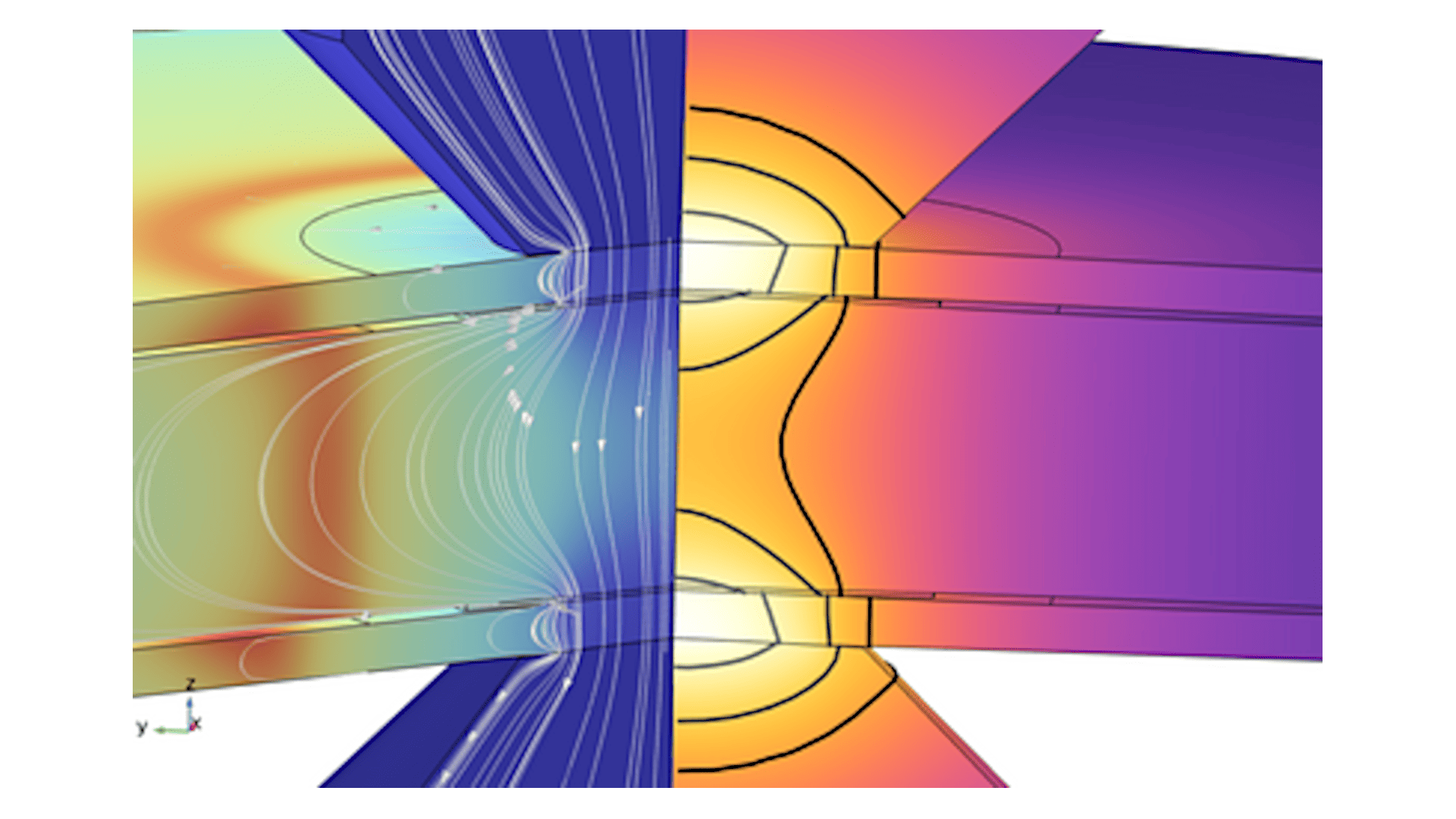
This work describes two complementary numerical models developed using COMSOL Multiphysics® for the simulation of resistance spot brazing (RSB), a joining process used in high-volume manufacturing industries. The objective is to improve the understanding and prediction of the brazing process by capturing the coupled electrical, thermal, and mechanical phenomena involved during operation. Two complementary numerical models are proposed.
The first one is a simplified three-dimensional electro-thermal model dedicated to investigating the influence of contact resistance on current distribution within the actual geometry of the assembly. This model is used to calibrate contact resistances through comparison with experimental results and to identify appropriate electrical contact conditions for the brazing process.
The second one is a fully coupled 2D axisymmetric electro-thermo-mechanical model, using the calibrated contact resistance, and intended to provide a more detailed description of the local multi-physical phenomena occurring during brazing. Both models are based on a finite element formulation that describes Joule heating due to current flow, heat transfer within the components and electrodes, and, for the 2D axisymmetric model, the resulting thermo-mechanical response of the materials. Particular attention is given to the treatment of contact interfaces, where electrical and thermal resistances evolve as a function of pressure, temperature, and surface conditions. These interface effects strongly influence local heat generation and, consequently, the temperature distribution within the brazing foil and the surrounding materials.
The results highlight significant temperature gradients within the brazing foil, demonstrating the potential for local regions to reach the melting temperature while others remain below it. The proposed framework provides a predictive tool for analyzing and optimizing resistance spot brazing operations. It can be used to reduce reliance on trial-and-error experimentation and to support process design and optimization in industrial contexts.
Auteurs :
E. Bruyere
SCHNEIDER ELECTRIC, 31 rue Pierre Mendès France, EYBENS, France
V. Bruyere
SIMTEC, 5 rue Felix Poulat, GRENOBLE, France
G. Collot
SCHNEIDER ELECTRIC, 31 rue Pierre Mendès France, EYBENS, France
F. Garcia
SCHNEIDER ELECTRIC, 31 rue Pierre Mendès France, EYBENS, France
C. Durand
SCHNEIDER ELECTRIC, 31 rue Pierre Mendès France, EYBENS, France
P. Namy
SIMTEC, 5 rue Felix Poulat, GRENOBLE, France
A.C. Donnenwirth
SCHNEIDER ELECTRIC, 31 rue Pierre Mendès France, EYBENS, France